College Without High School by Blake Bole
Circa 2009 -2010
This website was created to promote Blake Bole's book, College Without High School.
Content is from the site's 2009 -2010 archived pages.


What would you do if you could go to college without high school?
Would you travel abroad, spend late nights writing a novel, volunteer in an emergency room, or build your own company? What dreams would you be pursuing, right now?
College Without High School is a book for teens who want to pursue their dreams outside of high school, while keeping the option of attending a 4-year college or university.
College Without High School is a guidebook for teens who are bored or frustrated with high school. In it you’ll learn how to define your dreams, replace school with adventure, and and still go to a top-choice college.

Did you know:
Gaining admission to college (from state universities to the Ivy Leagues) doesn’t require a high school diploma, transcript, or four years of classes?
You can use self-designed teenage adventures like international volunteering, internships, and independent research to prove college preparation?
Praise for College Without High School:
"Words fail me. This is the most inspiring, convincing, and practical case for self-directed learning that I've seen in many years. Mr. Boles draws on time management principles from the business world and on his own adventure-packed youth to map out a brilliantly simple way that people can live life to the fullest while also preparing masterfully for admission to college. If you believe, as I do, that our time on earth is a grand gift not to be squandered, then buy this book for all the teenagers you love, and watch as all manner of quests, discoveries, inventions, and miracles emerge."
Grace Llewellyn, author of The Teenage Liberation Handbook: how to quit school and get a real life and education and Real Lives: Eleven Teenagers Who Don't Go to School Tell Their Own Stories
"Blake Boles has found the solution for those students who find regular high school oppressive. Outstanding advice! His book is absolutely right on about the many options for success for students who have a little different approach to life and study."
Donald Asher, author of Cool Colleges For the Hyper-Intelligent, Self-Directed, Late Blooming, and Just Plain Different
"College Without High School is an excellent update to the groundwork provided by John Holt, the Colfaxes, Grace Llewellyn, and other unschoolers. I found it engaging and filled with concrete understanding and useful suggestions for Self Directed Learners of all ages, in or out of school."
Cafi Cohen, author of And What About College?: How homeschooling leads to admissions to the best colleges and universities
"Blake Boles shares what homeschoolers have known for decades: teens are thriving everywhere without attending school! Blake will inspire you to seize the day and live well now, with every bit of confidence that the doors to college will be wide open to you. I am thrilled to have another messenger trumpet the truth that school is optional. I recommend all parents and educators to acquaint themselves with this information."

Kenneth Danford, co-founder and executive director of North Star: Self-Directed Learning for Teens
"This splendid book is intended as a step-by-step guide, but can be read with profit by anyone interested in moral philosophy. Exceptionally clear, insightful, and lively, it will take its place as the definitive work on the subject."
John Taylor Gatto, author of Dumbing Us Down, The Underground History of American Education, and Weapons of Mass Instruction
"Boles offers an antidote to the over-scheduled, grade-driven, and sadly uncreative existence of most high-schoolers today. Not completing high school does not relegate you to a life around only janitorial supplies and maintainence products. Life is much more than classes and exams and it's time for teens to take control of their own education. Yes, they must learn the basics. Absolutely. But as Boles explains, self-motivated teens can cover those topics efficiently and free up more of their time for further learning. This book is a crucial guide for students and parents interested in replacing the old carrot and stick that's at the heart of today's education system with intrinsic motivation--self-directedness and autonomy that leads to real learning and growth."
Daniel H. Pink, author of A Whole New Mind and The Adventures Of Johnny Bunko
"College Without High School is a fantastic resource for homeschoolers who want to stand out from the rest of the college admissions pack. However, especially for unschoolers and other eclectic learners, it is also an inspirational description for how adventurous self-directed learning can lead to college admission. This is an entertaining workbook, how-to manual, and educational philosophy text that will help teenagers and their families figure out how to get into college without a conventional high school degree."
Patrick Farenga, co-author of Teach Your Own: The John Holt Book of Homeschooling

About Blake Boles
Blake Boles realized halfway through an astrophysics major that school and education are not the same thing.
Blake runs Unschool Adventures, a company that leads innovative trips for self-directed teens. He is the former acting director of Deer Crossing Summer Camp, an advisor to unschooled teens at Not Back to School Camp, a Wilderness First Responder and a UC Berkeley graduate.
News
News updates are no longer being posted on this webpage -- please check the Facebook page or blakeboles.com for news.
10/21/09: Book Release Party in San Francisco at Modern Times Bookstore!
10/15/09: MacLean's article: "University without high school"
9/3/09: Interview on Everyday Learning Magazine.
University without high school
This alternative-education advice (including how to get parents onside) is aimed at teens
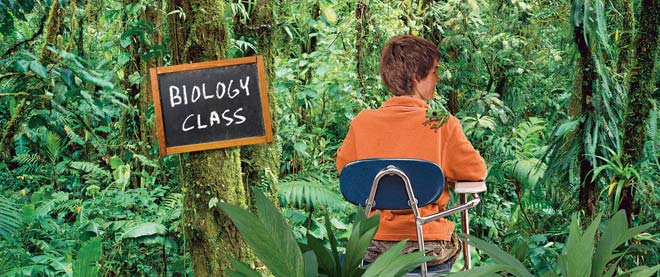
“Choosing to leave [high] school is an entrepreneurial move, not a cop-out” is the message of a new book aimed at teens, College Without High School. The author, Blake Boles, the co-founder of Unschool Adventures, writes, “Life is not a pyramid with doctors, lawyers and professors on the top, McDonald’s cashiers at the bottom and school the only ladder between.”
What does a high-schooler “who slaves away at meaningless disconnected problem sets every night become in later life?” he asks. “She becomes an adult who slaves away at a job she doesn’t enjoy, for less money than she deserves, for a one-week vacation through which she would prefer to sleep.” Boles’s book offers teens step-by-step advice on how to drop out of high school to tag tree frogs in Costa Rica or teach basic computer skills in Tanzania. It also shows how to condense schoolwork to meet admission requirements for university later on.
Boles studied astrophysics at the University of California, Berkeley, but left after hitting an “intellectual wall: quantum mechanics.” A book by New York high school teacher John Gatto inspired him to rethink his path. “I’ve noticed a fascinating phenomenon in my 25 years of teaching,” wrote Gatto, and that was “that schools and schooling are increasingly irrelevant to the great enterprises of the planet. The truth is that schools don’t really teach anything except how to obey orders.”
To legally leave school, “the quickest, easiest ticket to freedom” is to become a homeschooler,” writes Boles. However, “I don’t advocate becoming a home-schooler in the common misconception of the word. I don’t want you to stay home all day, following the prescribed 10th grade curriculum and cut yourself off from the world.”
Instead of wasting time in a classroom, shuffling around hallways, Boles believes that academic material can be learned in a fraction of the time through online courses, tutors or auditing classes. “Common sense tells you to give yourself plenty of time to get an important task done. Forget common sense in this case. To tackle a big project, begin by giving yourself an unreasonably small time quota.” He suggests students keep their schoolwork hours to a minimum. “If you can learn chemistry in eight weeks at four hours per week instead of 30 weeks at eight hours per week, do it. A short deadline is superior to a long one because it has the psychological effect of making you do more work. This is Parkinson’s law: work expands to fill the time available for its completion.”
Do an internship with a small business, he suggests; the book even includes a script to follow when calling a business owner. Say, “Hi, my name is . . . I would like to do what you do and I want to help. There are a few specific things I want to learn but my first priority is assisting your business in any way I can.”
Wichita State University student Jenny Bowen dropped out of high school in the ninth grade to pursue her interest in ornithology. Boles reports that Jenny became an online authority in parrot forums, enlisted as a zoo volunteer and then interned for three years at an exotic animal veterinary clinic. In 2006, “with little more than a homemade unschooling transcript and ACT score, Jenny applied to and entered Wichita State as a pre-veterinary biology major.”
For other “unschoolers” who want to go to university, Boles advises calling undergraduate admissions and asking if the school has any specific admissions requirements or advice for home-schooling students. “Be sure to track your progress with documentation. In the language of college admissions: if it’s not on paper, it didn’t happen.”
At the University of Toronto, for instance, home-schooled students are welcomed, though they are recommended to “consult with us well in advance since an individual assessment of your qualifications will be necessary.” U of T does not require a high school diploma but does want to see results of standardized tests such as SAT 1 and 11.
“Unschoolers aren’t Einstein-like geniuses,” Boles writes. “They’re normal teens who, unsatisfied with school’s plan for their future, chose to get an education on their own terms.” As for getting parents onside, Boles says he tells teens to find other local unschooling parents. “Seeing at least one real-life unschooling family helps parents for whom the concept is scary. There are definitely Canadian teen unschoolers. I know a lot of them in the Vancouver area. Join a Facebook unschooling group and ask around.”
9/21/09: Interview with Maya Frost, author of The New Global Student, on Converge Magazine.
College Without High School: An Interview With Blake Boles
3 September 2009
Contrary to what the local guidance counselor might have you believe, a high school diploma is not always necessary to go to college. In fact, you need not step foot onto a high school campus in order to find yourself roaming the grounds of the university of your choice. According to Blake Boles, author of “College Without High School: A Teenager’s Guide to Skipping High School and Going to College,” it is perfectly possible to make yourself an attractive candidate for an admissions office without sitting through History101.
If you think that means sitting on the couch, playing video games or constantly updating your Facebook page is going to get you into the school of your dreams, think again. Teens who want to bypass traditional high school will need to plan and research their way into college.
While the requirements differ from school to school, many private universities, such as the Massachusetts Institute of Technology (which does not require a high school diploma) are happy to look at alternatives to a traditional high school education. Boles, who runs the company Unschool Adventures, says there are five main attributes an admission officer looks for in a prospective student.
“Focus on results rather than volume,” he suggests. “Traditional high schoolers are more focused on pumping out volume. You know, GPA, SAT, community service; just doing more and more and sacrificing their lives in the process. I argue for showing the specific results that colleges want to see.”
Unschooled or homeschooled teens who want to prepare for college need to cultivate themselves in five areas, says Boles. They need to show internal passion, leadership, logical reasoning, a capacity for structured learning and background knowledge.
Boles suggests teens take classes at a local community college, which can show background knowledge, structured learning and logical reasoning. You need not take a full load each semester; a handful can show your ability to understand the material and fulfill the requirements. Teens can also prove their knowledge by studying for the SAT, CLEP or SAT subject tests.
Just don’t give yourself too long a period of time to prepare.
“Give yourself two weeks to study for that test,” he says. “It forces you to choose the practice problems in that CLEP testbook that are the most difficult for you. Hit your weakest spots. Get it done, don’t dawdle on the computer. Get it out of your mental space so you can enjoy the stuff that makes unschool worth it, not these little college prep hurdles.”
What to do when not studying for a standardized test? Get out and live life, says Boles, who is 26 and was traditionally schooled. He knows of teenagers who spend their time on internships, jobs, individual studies or travel. A wannabe veternarian might volunteer at a teen program at the zoo or help out at the local animal shelter. A future business student might start their own yard service while a hopeful botanist might volunteer as a WWOOFer (world wide opportunities on organic farms) for several months. Interested in history? Study the Holocaust, Puritans or Ancient Egypt– just keep a reading list of all that you do.
Just don’t stay at home all day, busying yourself with the computer and television.
“If you are spending your homeschooling days at home in front of the computer or the TV, then maybe you are missing out on something, because you are not taking full advantage of your opportunities as a self directed student,” he says. “Get the heck out of the house and go find the people who are doing the same stuff that interests you, especially those who are doing it for money. Those are the people who are engaged in the real work in the world. Go volunteer for someone, go propose an internship or go get hired.”
8/30/09: BOOK RELEASE! Find your copy now at NewSociety.com or Amazon.com.
7/20/09: Blog interview on Self Made Scholar.
6/29/09: Interview on Relaxed Homeskool Talk Radio

More Background On CollegeWithoutHighSchool.com
CollegeWithoutHighSchool.com was created around a provocative question: What if teenagers did not have to spend four years in a conventional high school in order to prepare themselves for college?
The website served as the online home for College Without High School: A Teenager’s Guide to Skipping High School and Going to College, the 2009 book by alternative-education writer Blake Boles. Rather than simply arguing against conventional schooling, Boles proposed a different model in which motivated teenagers could become self-directed learners, pursue substantial real-world interests and experiences, and simultaneously prepare themselves for admission to a four-year college or university.
That combination made CollegeWithoutHighSchool.com unusual. It was part book-promotion website, part introduction to unschooling and part practical argument about college admissions. Its intended audience included teenagers frustrated or bored by high school, homeschooling and unschooling families, parents wondering whether unconventional education would close the door to college, and educators interested in alternatives to traditional schooling.
Although the site's active period was relatively brief, its subject remains part of a much larger discussion about what education is supposed to accomplish and whether classrooms, grades, transcripts and diplomas are the only credible evidence that a teenager is prepared for adult life.
The Website and the Book Behind It
CollegeWithoutHighSchool.com was closely identified with Blake Boles and his first book. The book was published in 2009 by New Society Publishers, an independent Canadian publisher based on Gabriola Island, British Columbia. Library records describe the print edition as a 176-page book and identify New Society Publishers as its publisher. Its ISBN is 978-0-86571-655-1.
The subtitle—A Teenager’s Guide to Skipping High School and Going to College—summed up both the book and the website's central proposition.
Boles was not suggesting that teenagers simply stop learning. His argument was almost the opposite: teenagers capable of directing their own education could potentially learn more effectively by separating "education" from "school." They could devote significant amounts of time to independent study, employment, travel, volunteer work, internships, entrepreneurship, creative projects and other experiences while completing whatever academic preparation was necessary for their future plans.
The book's organization reflects that practical orientation. Its sections include discussions of redefining the teenage years, college preparation outside school, time management, creating adventures and eventually making the transition into the next stage of life. Library catalogs list chapters including "Redefining Teen," "College Prep Without School," "Six-Hour School Week," "Adventure Blender" and "Making the Leap."
CollegeWithoutHighSchool.com translated those ideas into a simple online introduction that could reach teenagers and parents searching the Internet for alternatives.
Blake Boles and the Origins of the Project
The story of CollegeWithoutHighSchool.com is closely tied to Boles's own changing ideas about education.
Boles studied astrophysics at the University of California, Berkeley. During college he encountered the work of alternative-education writers including John Taylor Gatto and Grace Llewellyn. Those ideas led him to reconsider the distinction between formal schooling and genuine education. He eventually redirected the latter part of his undergraduate experience toward education theory and became involved with communities of self-directed teenagers.
One especially important connection was Not Back to School Camp, a community for homeschooled and unschooled teenagers. Meeting teenagers who were learning outside conventional schools—and seeing that some were successfully moving on to four-year colleges—helped provide the practical foundation for the book.
Boles has explained that the manuscript began emerging while he was traveling in South America. He wrote notes about high school, college, unschooling and teenage leadership, later polished the manuscript and submitted it to two publishers. New Society Publishers accepted it. Boles has subsequently said that the publisher purchased the manuscript for C$5,000.
The book therefore emerged from a mixture of education theory, travel, direct contact with unschooled teenagers and Boles's own experiences questioning conventional educational structures.
What "Unschooling" Meant on CollegeWithoutHighSchool.com
Understanding the website requires distinguishing unschooling from simply dropping out.
In the model Boles promoted, leaving conventional high school was supposed to increase a teenager's responsibility rather than eliminate it. A self-directed student had to decide what he or she wanted to accomplish, locate appropriate resources, find mentors and opportunities, develop skills, complete projects and document achievements.
The teenager might study mathematics through a tutor or online program, take a community-college science course, learn history through intensive independent reading, work in a business, volunteer with an organization or develop expertise around a particular interest.
The larger goal was to replace a standardized sequence of classes with a deliberately constructed education.
Boles later continued developing this philosophy through Unschool Adventures and additional books. He founded and directed Unschool Adventures, which organized experiences for self-directed young people, and went on to write Better Than College, The Art of Self-Directed Learning and Why Are You Still Sending Your Kids to School? His career therefore shows that CollegeWithoutHighSchool.com was not an isolated publishing project; it represented the beginning of a longer body of work centered on educational autonomy.
The Five Results That Mattered for College
One of the book's more distinctive features was its attempt to translate unconventional education into evidence that a college admissions office could understand.
Instead of telling teenagers merely to accumulate conventional credentials, Boles focused on five broad results: intellectual passion, leadership, logical reasoning, capacity for structured learning and background knowledge.
The premise was that conventional students normally demonstrate these characteristics through grades, classes, recommendations, test results and extracurricular activities. An unschooled teenager needed to demonstrate comparable qualities in different ways.
For example, taking community-college classes could show that a student could function successfully in a structured academic environment. Standardized examinations could provide independent evidence of academic knowledge. An ambitious research project might demonstrate intellectual curiosity and persistence. Running a small business could show initiative and leadership. An internship could simultaneously provide professional experience, adult references and evidence of a sustained interest.
The point was not that colleges had no standards. The point was that teenagers could investigate what colleges actually wanted and then develop convincing evidence of preparation without necessarily spending four years following a conventional high-school schedule.
A later excerpt of the book published by Utne similarly described Boles's approach as demonstrating five preparatory results rather than simply reproducing traditional high-school experiences.
Adventure as an Educational Strategy
Perhaps the most memorable characteristic of CollegeWithoutHighSchool.com was the way it combined college preparation with adventure.
The site's message invited teenagers to imagine alternatives: traveling abroad, writing a novel, volunteering, starting a company, conducting independent research or developing another ambitious project.
These were not presented simply as extracurricular activities added to schooling. They could become the organizing framework of an education.
That approach reflected one of Boles's broader criticisms of conventional high school: teenagers often spend enormous amounts of time completing prescribed assignments while postponing their serious interests until adulthood.
The alternative proposed by College Without High School was to begin pursuing those interests during adolescence.
A teenager interested in animals, for example, could volunteer at a zoo or animal shelter, participate in online communities, obtain an internship at a veterinary clinic and independently study biology. Someone interested in business might start a small enterprise. A teenager interested in agriculture or environmental issues might work on a farm. Another interested in literature could undertake an extensive reading and writing project.
The model attempted to combine personal motivation with demonstrable accomplishment.
A Real-World Example: Jenny Bowen
One of the cases that attracted media attention involved Jenny Bowen, a teenager interested in ornithology and animals.
According to coverage of Boles's book, Bowen left conventional high school after ninth grade and developed expertise through activities outside school. She participated in parrot-related online communities, volunteered at a zoo and spent several years interning at an exotic-animal veterinary clinic. She ultimately applied to Wichita State University using an unconventional educational record along with an ACT score and entered as a pre-veterinary biology student.
The importance of stories like Bowen's was not simply that an unschooled teenager got into college. They demonstrated the type of educational substitution Boles advocated.
Instead of asking, "What classes replace tenth grade?" the model asked, "What knowledge, skills, experiences and evidence will demonstrate that this teenager is prepared for what comes next?"
That is a substantially different way of thinking about secondary education.
College Admissions and Documentation
The college-admissions component was crucial because fear about admission is one of the strongest reasons families may hesitate to consider homeschooling or unschooling during the high-school years.
Boles emphasized researching individual institutions rather than assuming that every college followed identical rules.
That remains an important distinction. Colleges can have different requirements for homeschooled applicants, and admissions policies can change. An applicant following an unconventional educational path therefore needs to verify current requirements directly with each institution.
Documentation was also central to Boles's approach. Independent learning might be meaningful to the teenager, but an admissions officer needs something tangible to evaluate. Reading lists, project records, transcripts created for homeschool purposes, community-college grades, test results, recommendations, portfolios and descriptions of internships or volunteer experiences can convert an unconventional education into an understandable admissions record.
In other words, self-directed learning did not mean undocumented learning.
Press and Media Attention
The book attracted media attention almost immediately after publication.
One notable article was Julia McKinnell's "University without high school," published by Maclean's in October 2009. The article introduced readers to Boles's argument that leaving high school could represent an entrepreneurial educational decision rather than simply abandoning education. It discussed the book's suggestions for experiential learning, college preparation and gaining parental support.
The book's launch period also included interviews and appearances within homeschooling and alternative-education media. Boles later built a considerably larger public profile around self-directed education. His work has appeared or been discussed in outlets including The New York Times, The Christian Science Monitor, BBC Travel, Psychology Today, Fox Business, The Huffington Post, USA Today, NPR-affiliate radio, and blogs associated with Wired and The Wall Street Journal. He has also delivered more than 80 presentations to education conferences, alternative schools and parent groups.
It is important to distinguish that broader career coverage from direct coverage of CollegeWithoutHighSchool.com itself. The domain was primarily a promotional and informational site associated with one book; Boles subsequently became the more enduring public identity.
Book Launch and San Francisco Connection
The website's historical news section documented promotional activity surrounding the 2009 publication.
A book-release event was scheduled for October 21, 2009, at Modern Times Bookstore in San Francisco. That San Francisco/Bay Area connection made sense given Boles's UC Berkeley background and his involvement in West Coast alternative-education communities.
The publisher itself was located much farther north, on Gabriola Island in British Columbia, Canada. Thus the project was not best understood as a local website serving one geographic community. Its subject and audience were North American and potentially international.
That geographical flexibility mirrored the book itself. Its educational model encouraged teenagers to look beyond a school building—and sometimes beyond their own communities—for educational opportunities.
Endorsements from the Alternative-Education World
The book received endorsements from several well-known figures associated with homeschooling, unschooling, education reform and independent learning.
They included Grace Llewellyn, author of The Teenage Liberation Handbook; Donald Asher; homeschooling writer Cafi Cohen; North Star co-founder Kenneth Danford; education critic John Taylor Gatto; author Daniel H. Pink; and Patrick Farenga, a prominent advocate of John Holt's homeschooling ideas.
These endorsements help place the book historically.
Boles did not invent unschooling. His work followed decades of criticism of compulsory and highly standardized schooling, particularly the ideas associated with John Holt, Gatto, Llewellyn and others.
What College Without High School contributed was a distinctly college-oriented version of the argument aimed directly at teenagers. It addressed a practical concern that could prevent even education-reform-minded families from embracing self-directed learning: "But what about college?"
Reviews and Popularity
The book developed a respectable readership for a specialized alternative-education title.
Boles's current website reports that more than 5,000 paperback copies and more than 1,400 digital editions had been sold by 2025. That does not make it a mass-market bestseller, but it demonstrates sustained interest in a book addressing a comparatively narrow segment of the education market.
Reader response has also remained generally favorable. Goodreads showed a rating of approximately 4.15 out of 5 based on 194 ratings and 31 reviews when researched. Roughly four-fifths of the ratings were four or five stars.
The reviews also reveal useful criticisms. Some readers praised the book as practical, inspiring and reassuring for homeschooling families. Others thought it needed more detailed examples, such as sample admissions portfolios or more specific instructions. Some objected to its occasionally dismissive attitude toward conventional schooling or noted that travel-heavy examples could seem unrealistic for teenagers without the money or parental support necessary to pursue them.
Those criticisms highlight an important limitation of the model. Self-directed education can provide extraordinary freedom, but freedom itself is a resource. A teenager needs some combination of supportive adults, transportation, financial resources, community opportunities, Internet access, mentors and personal initiative to turn that freedom into a substantial education.
The Website's Goals and Intended Audience
CollegeWithoutHighSchool.com had a much more specific purpose than a general homeschooling portal.
Its primary audiences were teenagers unhappy with conventional high school and parents concerned about the consequences of allowing a child to follow another path.
The website attempted to accomplish several things simultaneously: promote the book, reassure families that college could remain possible, introduce unschooling, demonstrate the seriousness of self-directed education, publicize interviews and reviews, and connect Boles with a developing alternative-education audience.
Its strongest message was not "avoid college." In fact, the book assumed that many readers wanted college.
Instead, the argument was that college should not force a teenager to spend the preceding four years in a particular educational institution.
That distinction separates College Without High School from more radical arguments questioning higher education altogether.
From CollegeWithoutHighSchool.com to Blake Boles's Larger Work
The original website eventually stopped functioning as an actively updated news platform. Boles's broader website and other projects became the main places to follow his work.
His later career suggests a natural evolution of the original idea.
College Without High School dealt primarily with teenagers who wanted alternatives to secondary school while preserving access to college. Better Than College extended the self-directed-learning argument into the college-age years. The Art of Self-Directed Learning broadened the concept beyond one educational stage. Unschool Adventures put many of the experiential principles into practice through programs for self-directed young people.
Boles's current biography describes a career devoted to helping young people build unconventional educational paths, and Unschool Adventures identifies him as its founder/director and trip leader.
Seen retrospectively, CollegeWithoutHighSchool.com represents an early digital chapter in that larger career.
Cultural and Social Significance
The site's significance lies less in its size than in the educational assumption it challenged.
For generations of American students, high school and college have been presented as consecutive stages: complete elementary school, complete middle school, earn a high-school diploma and then apply to college.
CollegeWithoutHighSchool.com challenged the inevitability of the third step.
Its argument was that education could be organized around outcomes rather than attendance. If a teenager could demonstrate intellectual curiosity, academic knowledge, logical reasoning, disciplined learning and meaningful accomplishment, why should the physical location or institutional structure through which those qualities developed be the deciding factor?
That question connects the website to larger movements involving homeschooling, unschooling, democratic schools, gap years, experiential education, online learning, dual enrollment, competency-based education and personalized learning.
Not every teenager would thrive under such a system. Some benefit greatly from the structure, teachers, athletics, clubs, friendships and community available through traditional schools. Self-direction can also be difficult, and access to alternative opportunities is not distributed equally.
Nevertheless, the website's lasting contribution was to make the conventional sequence seem less inevitable.
Why CollegeWithoutHighSchool.com Is Worth Remembering
CollegeWithoutHighSchool.com captured a particular moment in the development of Internet-era alternative education.
When the book appeared in 2009, online education was growing but had not yet become as ordinary as it would later become. Social media was still relatively young. Remote learning had not been normalized by the experiences of the 2020s, and many families still associated homeschooling primarily with parents recreating conventional school lessons at home.
Boles presented something different: an outward-facing education based on independence, projects, work, travel, mentors, community resources and selective use of formal academics.
The book remains available years after its publication, and Boles reports thousands of print and digital sales. Its Goodreads activity demonstrates that readers have continued discovering and discussing it long after the original promotional period.
CollegeWithoutHighSchool.com therefore deserves to be remembered not simply as an old promotional website for a 2009 book, but as an artifact of the modern self-directed-learning movement.
Its underlying question remains provocative: If education is supposed to prepare a young person to think independently, pursue meaningful goals and participate effectively in adult life, must every teenager reach those goals through exactly the same institutional path?
Blake Boles and College Without High School answered no.
For the teenagers and families attracted to that answer, the website offered something more important than permission to leave school. It offered a framework for thinking about what they would build in its place.
